[et_pb_section fb_built=”1″ _builder_version=”4.16″ custom_padding=”1%||1%||false|false” da_disable_devices=”off|off|off” collapsed=”off” global_colors_info=”{}” da_is_popup=”off” da_exit_intent=”off” da_has_close=”on” da_alt_close=”off” da_dark_close=”off” da_not_modal=”on” da_is_singular=”off” da_with_loader=”off” da_has_shadow=”on”][et_pb_row _builder_version=”4.16″ background_size=”initial” background_position=”top_left” background_repeat=”repeat” global_colors_info=”{}”][et_pb_column type=”4_4″ _builder_version=”4.16″ custom_padding=”|||” global_colors_info=”{}” custom_padding__hover=”|||”][et_pb_text _builder_version=”4.27.4″ background_size=”initial” background_position=”top_left” background_repeat=”repeat” global_colors_info=”{}”]
What if the key to eating less and weighing less isn’t another diet—but a radical return to food as nourishment for body, mind, heart, and soul? Discover Whole Person Integrative Eating®, the science-backed dietary lifestyle that treats the root causes of overeating.
Here, an overview of the interview with Deborah Kesten. And a link to the Q&A.
If you’ve ever felt discouraged by yet another diet that didn’t work, you’re not alone. Maybe you’ve counted calories, cut carbs, or followed strict plans—only to watch the weight return and your hope fade. It’s disheartening. But here’s the truth: it’s not your willpower that’s broken—it’s the diet mentality itself. There is another way. A way to eat less, weigh less, and feel at peace with food—without dieting.
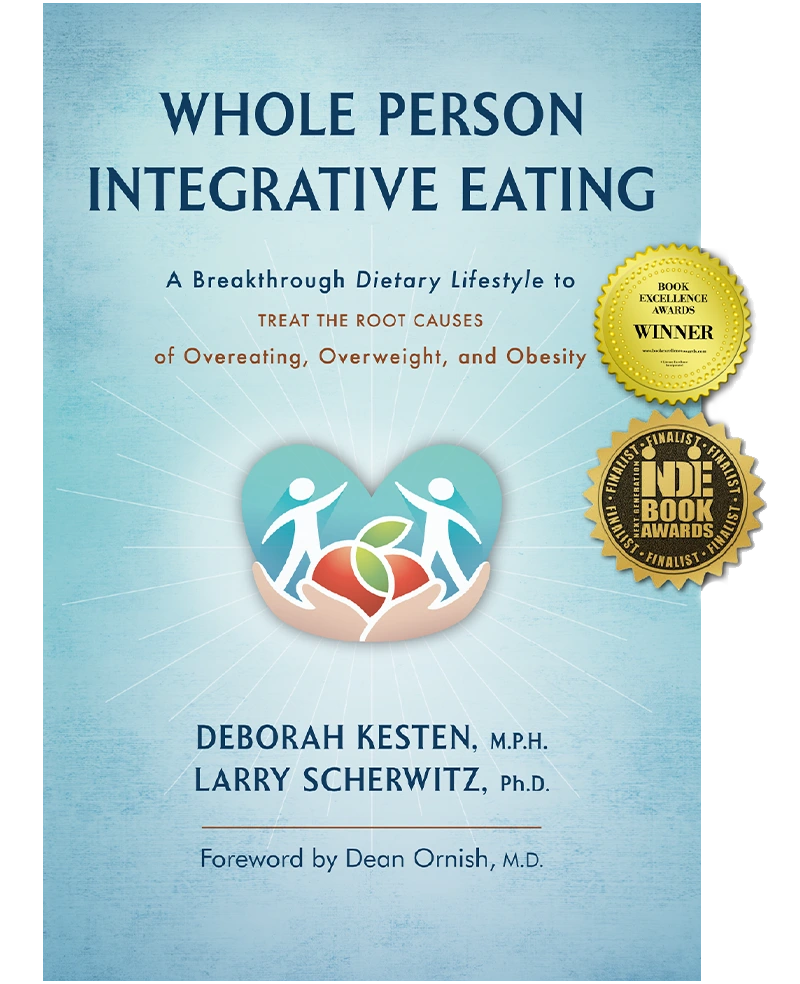
Enter Whole Person Integrative Eating® (WPIE)—my science-backed program that leads to eating less and weighing less, which I developed with behavioral scientist and WPIE Co-founder Larry Scherwitz, PhD. WPIE isn’t a quick fix or restrictive regimen. Rather, it’s a timeless, science-backed dietary lifestyle—inspired by ancient food wisdom and validated by modern nutrition research—that treats the root causes of overeating and weight gain. And it does so by nourishing all of you: physically, emotionally, spiritually, and socially.
The Wisdom of the Ancients
The seeds of WPIE were planted during my “nutrition journey around the world,” inspired by a conversation in New Delhi, India, with cardiologist Dr. K.L. Chopra. When I asked Dr. Chopra about diet in relation to yoga, he responded with this ancient insight from Hinduism: “When you cook with love, you transfer the love into the food and it is metabolized.”
Food and love. The thought wouldn’t let go. Intrigued, I studied other major world religions, cultural traditions, and Eastern healing systems—from Buddhism to Ayurveda to Native American foodways—to unearth their universal principles of optimal eating.
The result? Seven perennial guidelines emerged across traditions, which mapped into four dimensions of eating:
- Biological Nutrition (Eat fresh, whole food in its natural state)
- Psychological Nutrition (Be aware of feelings and surroundings while eating)
- Spiritual Nutrition (‘Infuse’ meals with mindfulness, gratitude, and loving regard)
- Social Nutrition (Eat with others as often as possible)
These elements, which comprise the core of Whole Person Integrative Eating, are the opposite of what (food choices) and how (eating behaviors) most of us eat today. Larry and I call today’s typical way of eating “overeating styles.” Here’s what I mean.
From Overeating Styles to Integrative Nourishment
In addition to the perennial principles of Whole Person Integrative Eating, Larry and I discovered seven new-normal overeating styles that are the opposite of what and how we ate for millennia. These newly identified overeating styles are (strongly) linked with overeating and are likely contributing to overeating and overweight with which millions struggle. They are:
- Emotional Eating (eating when experiencing negative feelings)
- Fast Foodism (a diet of mostly fast, ultra-processed foods)
- Food Fretting (obsessive dieting)
- Task Snacking (eating while doing other things)
- Sensory Disregard (not taking time to savor flavors)
- Unappetizing Atmosphere (eating in unpleasant emotional and aesthetic environments)
- Solo Dining (eating alone most of the time)
When Larry and I did research on the link between weight, the overeating styles, and the seven perennial principles of Whole Person Integrative Eating, here’s what we discovered:
The more study participants followed the overeating styles, the more they overate and were overweight or obese. Conversely, those who replaced their overeating styles during the 18-lesson, 6-week, online e-course, with WPIE principles, ate less and lost weight—without dieting.
WPIE in Action
Here’s a personal story of how WPIE works. Barbara Kumara, a Chopra-trained meditation teacher, was 64 when she contacted me after a lifetime of obesity. From dieting and Overeaters Anonymous to acupuncture, nothing had brought her lasting weight loss.
Throughout our year-long coaching sessions, Barbara discovered how to replace her overeating styles with the elements of Whole Person Integrative Eating. The results? She lost about 70 pounds in a year—without ever “going on a diet.” Two years later, she had kept the weight off and wears a size 12. As important, she felt at peace with food—and herself.
The Takeaway
Over the decades, our culture has normalized a broken relationship with food. We eat lots of ultra-processed food (products) on autopilot. We eat when stressed. We eat alone, while multitasking, disconnected from both our food and ourselves.
WPIE provides an antidote to this new-normal way of eating. And it’s not a restrictive diet. Rather, it’s a dietary lifestyle—not a temporary fix–that revives the original meaning of the word diet. In ancient Greece, “diaita” meant a “way of life,” not calorie counting. Over time, that meaning was lost, and dieting became about deprivation.
Like the gold-standard Mediterranean diet, WPIE reclaims the true meaning of diet as a path to weight loss and well-being. It guides us to nourish our whole selves—not just our bodies—each time we eat. And research on Whole Person Integrative Eating suggests this simple yet radical shift leads to eating less and weighing less. Without dieting.
[/et_pb_text][et_pb_text _builder_version=”4.27.4″ background_size=”initial” background_position=”top_left” background_repeat=”repeat” global_colors_info=”{}”]
 READ THE INTERVIEW: A Conversation with Deborah Kesten
https://www.deliveryrank.com/blog/whole-person-integrative-eating-interview
[/et_pb_text][et_pb_text disabled_on=”on|on|on” _builder_version=”4.27.4″ background_size=”initial” background_position=”top_left” background_repeat=”repeat” disabled=”on” global_colors_info=”{}”]
What if the key to eating less and weighing less isn’t another diet—but a radical return to food as nourishment for body, mind, heart, and soul? Discover Whole Person Integrative Eating®, the science-backed dietary lifestyle that treats the root causes of overeating.
In a world where 73% of U.S. adults are overweight or obese—and nearly half are dieting right now—it’s clear: diets aren’t working. Most people will try dozens of diets in their lifetime, only to see the pounds creep back on. Now there’s an alternative to following a model that keeps failing us.
Enter Whole Person Integrative Eating® (WPIE)—a science-backed, profoundly different approach to eating less and weighing less developed by nutrition researcher, author, and coach Deborah Kesten, MPH–author of this article–and behavioral scientist Larry Scherwitz, PhD. WPIE isn’t a quick fix or restrictive regimen. Rather, it’s a timeless, science-backed dietary lifestyle—inspired by ancient food wisdom and validated by modern nutrition research—that treats the root causes of overeating and weight gain. And it does so by nourishing all of you: physically, emotionally, spiritually, and socially.
The Wisdom of the Ancients
The seeds of WPIE were planted during my “nutrition journey around the world,” inspired by a conversation with Indian cardiologist Dr. K.L. Chopra. When I asked Dr. Chopra about diet in relation to yoga, he responded with this ancient insight from Hinduism: “When you cook with love, you transfer the love into the food and it is metabolized.”
Food and love. The thought wouldn’t let go. Intrigued, I studied other major religions, cultural traditions, and Eastern healing systems—from Buddhism to Ayurveda to Native American foodways—to unearth their universal principles of optimal eating.
The result? Seven perennial guidelines emerged across traditions, which mapped into four dimensions of eating:
- Biological Nutrition (Eat fresh, whole food in its natural state)
- Psychological Nutrition (Be aware of feelings and surroundings while eating)
- Spiritual Nutrition (Bring mindfulness, gratitude, and love to food)
- Social Nutrition (Eat with others as often as possible)
These elements became the core of Whole Person Integrative Eating.
From Overeating Styles to Integrative Nourishment
In addition to the perennial principles of Whole Person Integrative Eating, Larry and I discovered seven new-normal overeating styles that are the opposite of what and how we ate for millennia. It is these overeating styles that are linked with overeating and are contributing to the obesity epidemic. They are:
- Emotional Eating
- Fast Foodism
- Food Fretting (obsessive dieting)
- Task Snacking (eating while doing other things)
- Sensory Disregard
- Unappetizing Atmosphere
- Solo Dining
These new-normal overeating styles contribute to overeating by disconnecting us from our bodies, emotions, and the deeper meaning of meals. When Larry and I did research on the link between weight, the overeating styles, and the seven perennial principles of Whole Person Integrative Eating,
The more study participants followed these styles, the more likely they were to be overweight or obese, we discovered:
Research participants who replaced the overeating styles with WPIE principles consistently ate less and lost weight—without dieting.
A Story of Transformation
Barbara Kumara, a meditation teacher, was 64 when she turned to WPIE after a lifetime of dieting failures. From Overeaters Anonymous to acupuncture, nothing had brought her lasting peace—or weight loss.
With WPIE, Barbara didn’t start by cutting calories. She started by reconnecting with joy, beauty, and self-care. She swapped her stressful eating environments for beautiful placemats and fresh, whole meals. She learned to identify her emotional triggers and bring mindful awareness to eating.
The results? Barbara lost about 70 pounds in a year—without ever “going on a diet.” Two years later, she had kept the weight off. More importantly, she felt at peace with food—and herself.
Diet as a Way of Life
WPIE isn’t just backed by tradition—it’s affirmed by science. For instance, the world-renowned Mediterranean diet, consistently ranked the #1 healthiest way of eating, mirrors the elements of WPIE. It emphasizes fresh, plant-based foods (Biological Nutrition), is eaten with others (Social Nutrition), in beautiful, calm environments (Psychological Nutrition), and with gratitude and pleasure (Spiritual Nutrition).
Crucially, it’s not restrictive. Like WPIE, it’s a lifestyle—not a temporary fix.
And here’s something else WPIE revives: the original meaning of the word diet. In ancient Greece, “diaita” meant a “way of life,” not calorie counting. Over time, that meaning was lost, and dieting became about deprivation. WPIE reclaims the true meaning of diet as a path to wholeness.
The Science of Food and Soul
Modern research is catching up with what ancient cultures already knew: how you eat is as important as what you eat.
- Studies in nutritional epigenetics show your food choices may switch genes on or off—toward wellness or illness.
- Gut health research reveals the microbiome’s role in weight, mood, and overall well-being—and that what and how you eat shapes it.
WPIE is aligned with this exciting science. It invites us to eat in ways that heal not just the body, but the whole person.
The Takeaway
Our culture has normalized a broken relationship with food. We eat on autopilot. We eat when stressed. We eat alone, while multitasking, disconnected from both our food and ourselves.
WPIE provides an antidote to this new-normal way of eating. It guides us to nourish our whole selves—not just our bodies—each time we eat. This simple yet radical shift can help people eat less and weigh less, without dieting.
—
If you’d like to discover your personal overeating styles and begin your own WPIE journey, visit IntegrativeEating.com to take the self-assessment and explore next steps in healing your relationship with food.
READ THE INTERVIEW: A Conversation with Deborah Kesten
https://www.deliveryrank.com/blog/whole-person-integrative-eating-interview[/et_pb_text][/et_pb_column][/et_pb_row][/et_pb_section]